Showing posts with label Carl Sagan. Show all posts

Sunday, January 30, 2011

Andromeda (M31)

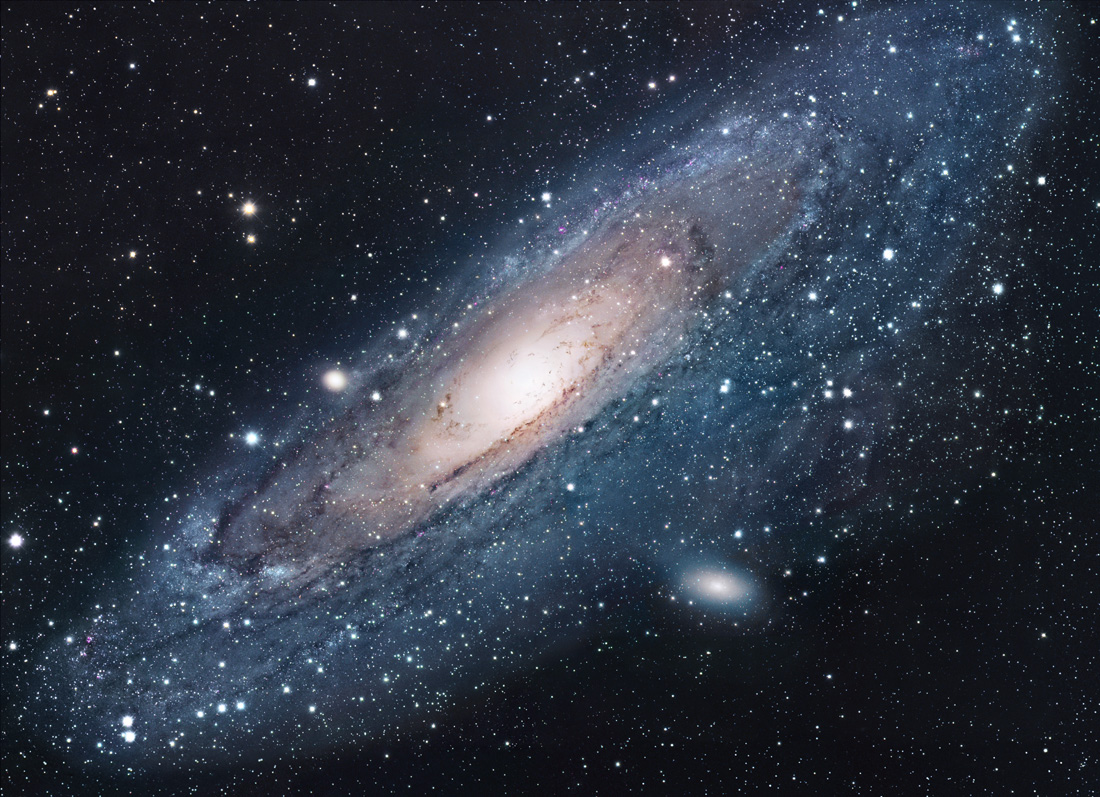
The closest spiral galaxy to our own is the Andromeda Galaxy, known more formally as Messier 31 or M31. Although other galaxies are closer to us, Andromeda is probably the closest galaxy that actually resembles our own Milky Way. It can be seen as a faintish smudge in the sky with the naked eye, and even in urban areas it is visible with telescopes/binoculars. When photographed with a large telescope, it is 6 times as wide as the full moon. Andromeda is about 2.54 million light years (14,931,708,447,886,365,000 miles) away from us, meaning that light takes 2.54 million years to travel from Andromeda to earth and we are seeing Andromeda as it appeared 2.54 million years ago--we are, in fact, as with all other space objects, looking back in time when we view Andromeda. This is part of the reason why astronomers and astrophysicists concern themselves with extremely distant objects (and Andromeda is very, very, very, very close to us, comparatively speaking)--the more distant in space you look, the further back in time you look, and thus you can learn more about the conditions of the earliest moments of the universe.

Andromeda (M31), from NASA's Astronomy Picture of the Day series
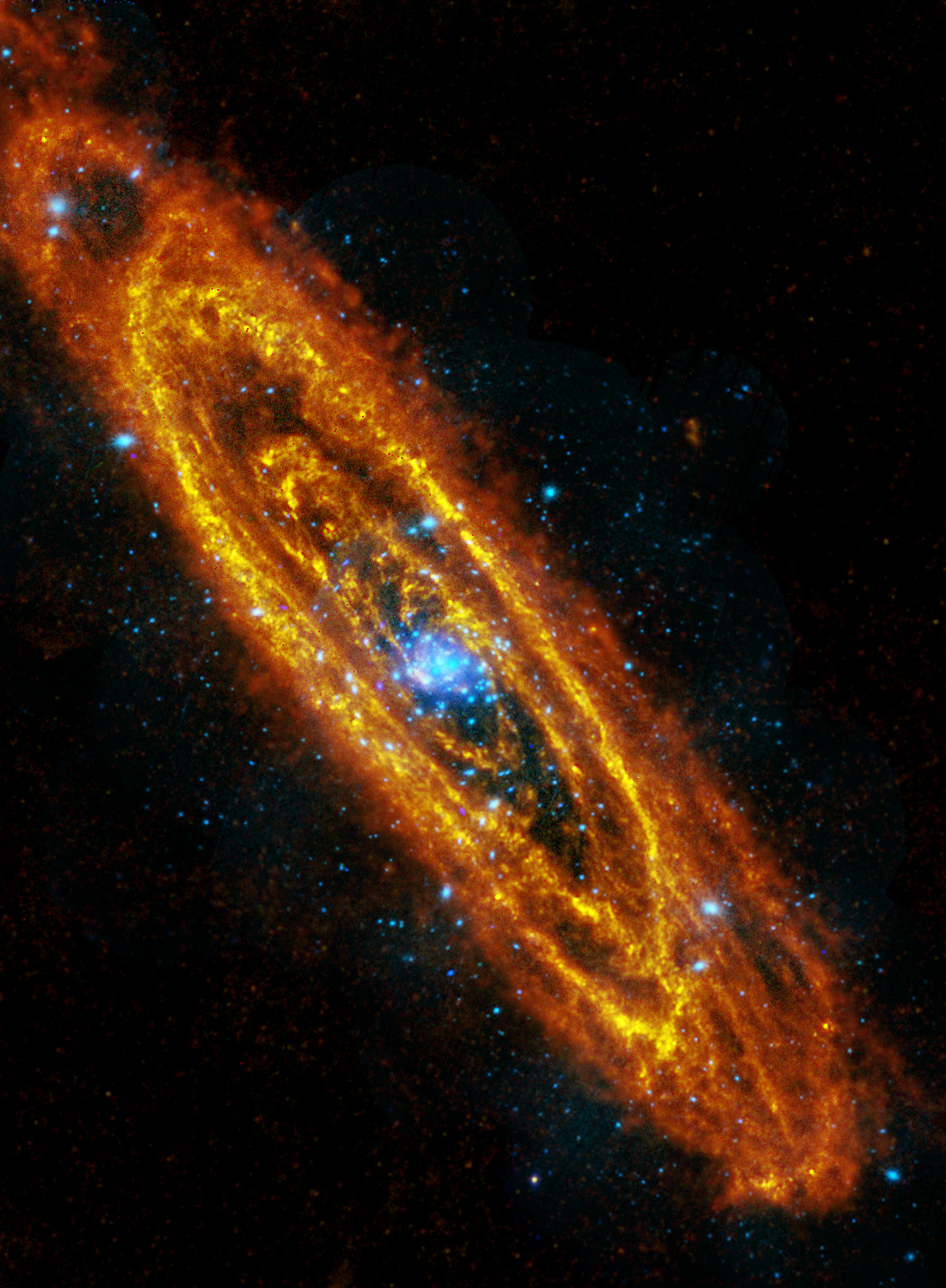
Andromeda is more than twice the size of the Milky Way, but telescopes and observatories can still capture it in all sorts of interesting ways. Below is Andromeda in infrared (the red parts--interstellar dust, mostly, sites of future star formation) and X-ray (the blue points--some binary stars in the final stages of stellar evolution) wavelengths.

apod.nasa.gov

Thursday, December 23, 2010

A morning filled with 400 billion suns

Auto-tuning is very popular in music nowadays, but it rarely adds anything to the music itself. Usually it just serves to make an otherwise terrible singer bearable to hear. On YouTube, however, there is an entertaining (and strangely beautiful) project called Symphony of Science that takes many famous popular scientists and creates auto-tuned songs that are really quite lovely, as well as bizarrely inspiring.

First up is "A Glorious Dawn," a remix of some Carl Sagan and Stephen Hawking, taken mostly from clips of Cosmos and set to that strangely resonating piano/synthesizer background. "The cosmos is full beyond measure of elegant truths, of exquisite interrelationships, of the awesome machinery of nature..."


The other one that my friends and I at U of C have really enjoyed over the past month or so is "We Are All Connected," which is faster-paced and includes some drumming in the style of featured scientist Richard Feynman. This one has a wider selection of scientists, including Sagan, Neil deGrasse Tyson, Feynman, and even Bill Nye (yes, the science guy, a legitimate scientist in his own right). "The beauty of a living thing is not the atoms that go into it but the way those atoms are put together. The cosmos is also within us; we're made of star stuff..."


"We've traveled this way before, and there is much to be learned."

Monday, November 29, 2010

Why Carl?

As the title of the blog hints, a lot of the design inspiration for this rag came from Carl Sagan, the famous popularizer of astronomy and astrophysics, yes, but also of science in general. He is perhaps most famous for Cosmos, the TV miniseries from 1980 with a lot of entertaining graphics and set designs, but its greatest virtue was Sagan himself and his voice, that bizarrely ethereal tone he had that made every word seem slightly poetic, even spiritual.

Carl Sagan died in December of 1996 after an arduous battle with myelodysplasia and something like three bone marrow transplants in an attempt to cure it. He was 62. Sagan's professional associations were mostly with Cornell University (he is buried in Ithaca), but he did his undergraduate work here at the University of Chicago, walking many of the very same halls that I walk now. I was five when Sagan died, but this year my room here at the U of C is the first room Sagan had in his undergraduate career; this box I live in currently was his box, for a while.

I'm taking astronomy/astrophysics for two quarters here for my physical sciences requirement. It's a class designed for nonmajors, aka people like me, but the subject matter is really interesting, and there's a happy kind of harmony in reading my astro textbook in a room where Sagan probably first started seriously studying astronomy himself. I like to think sometimes that he went through the same core curriculum, maybe read some Marx and Smith and Weber in this room, just the same as I currently do.

Carl Sagan was no god and no prophet and no priest; he was much humbler and more honest than that. He was, however, profoundly intelligent, profoundly entertaining, and profoundly able to communicate both science and practical philosophy in a way that conveys both the wonder and the humility entangled in our universe. For that, Carl Sagan has earned my immense respect and has helped to shape how I view the cosmos and my own tiny life within it, how much more beautiful the universe is when stripped of supernatural mysticism and left to its own natural glory.

"We are connected, not in the trivial ways that astrology promises but in the deepest of ways."